
Description
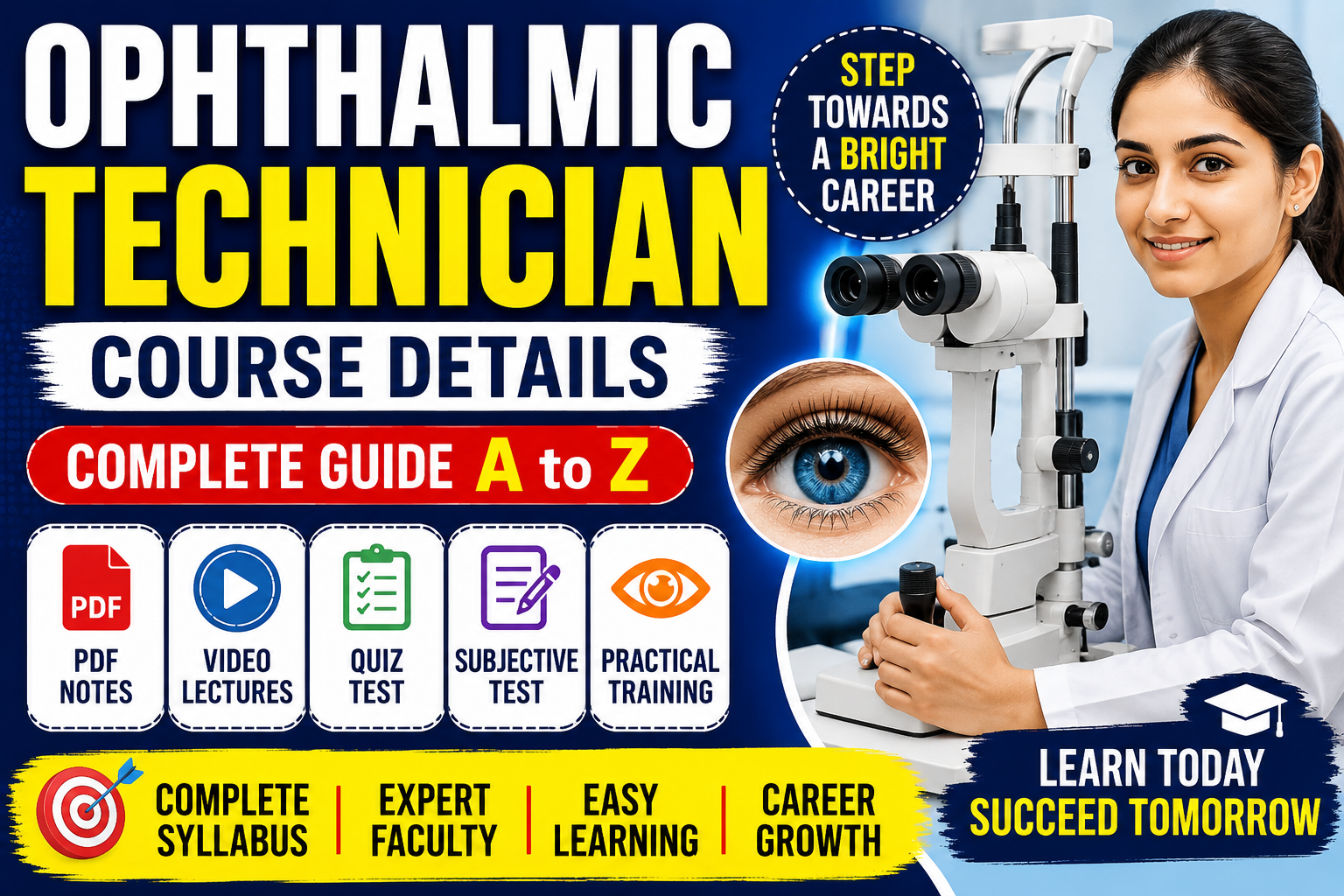
Ophthalmic Technician Course
The Ophthalmic Technician course trains students in basic eye care and ophthalmic clinical support. It covers eye anatomy, common eye diseases, diagnostic procedures, operation theatre assistance, use of ophthalmic instruments, and patient care. Graduates assist ophthalmologists in OPD, wards, and eye surgery units, playing a key role in eye examinations, procedures, and preventive eye care services.
Ophthalmic Technician Course – Complete Learning Program
Become a Skilled Ophthalmic Technician
The Ophthalmic Technician Course is designed to provide comprehensive knowledge and practical skills required for assisting ophthalmologists, performing eye examinations, operating ophthalmic instruments, and managing patients in eye care settings. This course is suitable for students, optometrists, ophthalmic assistants, vision technicians, and healthcare professionals who want to build a strong foundation in ophthalmology.
Our course combines structured study material, video lectures, PDF notes, quizzes, subjective assessments, and practical demonstrations to ensure complete understanding of ophthalmic science and clinical practice.
Why Choose This Course?
✔ Comprehensive syllabus covering basic to advanced ophthalmology
✔ Professionally prepared PDF notes for every topic
✔ High-quality video lectures with visual demonstrations
✔ Topic-wise MCQ quizzes for self-assessment
✔ Subjective tests for examination preparation
✔ Clinical case discussions and practical examples
✔ Suitable for competitive examinations and professional development
✔ Lifetime access to learning materials (if applicable)
Course Structure
The course is divided into multiple modules covering all major aspects of ophthalmology.
Module 1: Basic Sciences of Ophthalmology
Anatomy of Eye
-
Embryology of the eye
-
Orbit and ocular adnexa
-
Eyelids
-
Lacrimal apparatus
-
Conjunctiva
-
Cornea
-
Sclera
-
Uveal tract
-
Lens
-
Retina
-
Optic nerve
-
Visual pathway
Physiology of Eye
-
Tear secretion
-
Corneal physiology
-
Aqueous humour dynamics
-
Accommodation
-
Pupillary reflexes
-
Visual acuity
-
Colour vision
-
Binocular vision
-
Night vision
-
Visual field
Ocular Biochemistry
-
Corneal metabolism
-
Lens metabolism
-
Tear film composition
-
Oxidative stress
Module 2: Ocular Microbiology
-
Normal flora of eye
-
Bacterial infections
-
Viral infections
-
Fungal infections
-
Parasitic infections
-
Collection of ocular specimens
-
Laboratory diagnosis
-
Sterilization and disinfection
Module 3: Ocular Pharmacology
-
Routes of drug administration
-
Antibiotics
-
Antifungal drugs
-
Antiviral drugs
-
Steroids
-
NSAIDs
-
Mydriatics
-
Cycloplegics
-
Miotics
-
Anti-glaucoma medications
-
Local anaesthetics
-
Ocular lubricants
Module 4: Optics and Refraction
Basic Optics
-
Nature of light
-
Reflection
-
Refraction
-
Lenses
-
Prisms
-
Optical instruments
Refraction
-
Emmetropia
-
Myopia
-
Hypermetropia
-
Astigmatism
-
Presbyopia
Refraction Techniques
-
Retinoscopy
-
Subjective refraction
-
Cycloplegic refraction
-
Pediatric refraction
Module 5: Ophthalmic Instruments
Diagnostic Instruments
-
Torch examination
-
Loupe
-
Slit lamp
-
Keratometer
-
Retinoscope
-
Ophthalmoscope
-
Lensometer
-
Auto refractometer
-
A-scan
-
B-scan
-
OCT
-
Fundus Camera
-
Perimeter
Practical Demonstrations
-
Instrument handling
-
Calibration
-
Maintenance
-
Infection control
Module 6: Diseases of Eye
Eyelid Disorders
-
Blepharitis
-
Hordeolum
-
Chalazion
-
Ptosis
-
Entropion
-
Ectropion
Conjunctival Diseases
-
Acute conjunctivitis
-
Chronic conjunctivitis
-
Allergic conjunctivitis
-
Trachoma
-
Ophthalmia neonatorum
Corneal Diseases
-
Keratitis
-
Corneal ulcer
-
Corneal degeneration
-
Corneal dystrophy
Lens Disorders
-
Cataract
-
Congenital cataract
-
Complicated cataract
Glaucoma
-
Primary open-angle glaucoma
-
Angle-closure glaucoma
-
Congenital glaucoma
-
Secondary glaucoma
Retinal Diseases
-
Diabetic retinopathy
-
Hypertensive retinopathy
-
Retinal detachment
-
Macular degeneration
Neuro-Ophthalmology
-
Optic neuritis
-
Papilledema
-
Cranial nerve palsies
Module 7: Community Ophthalmology
-
National Programme for Control of Blindness (NPCB)
-
Vision screening
-
School eye health programs
-
Blindness prevention
-
Public health ophthalmology
Module 8: Ophthalmic Procedures
-
Visual acuity testing
-
Colour vision testing
-
Tonometry
-
Gonioscopy
-
Pachymetry
-
Visual field testing
-
OCT imaging
-
Fundus photography
Module 9: Operation Theatre Techniques
-
OT protocols
-
Sterilization
-
Surgical instruments
-
Cataract surgery assistance
-
Pre-operative preparation
-
Post-operative care
Learning Resources Included
PDF Notes
Every lecture includes downloadable PDF notes covering:
-
Definitions
-
Clinical features
-
Diagnosis
-
Differential diagnosis
-
Treatment
-
Examination points
-
MCQs
Video Lectures
Detailed video lectures covering:
-
Theory concepts
-
Instrument demonstrations
-
Clinical examination techniques
-
Surgical assistance procedures
-
Case discussions
Quiz Tests
Each topic contains:
-
Multiple Choice Questions (MCQs)
-
One-liner questions
-
Image-based questions
-
Instrument identification
Subjective Tests
Students will receive:
-
Short-answer questions
-
Long-answer questions
-
Case-based discussions
-
University examination pattern papers
Practical Skills Training
Students will learn:
-
Visual acuity assessment
-
Refraction techniques
-
Retinoscopy
-
Slit-lamp examination
-
Fundus examination
-
Intraocular pressure measurement
-
OCT interpretation
-
Fundus photography
-
Patient counselling
Who Should Enroll?
-
Ophthalmic Technician Students
-
Optometry Students
-
Vision Technicians
-
Ophthalmic Assistants
-
Medical Students
-
Nursing Professionals
-
Eye Hospital Staff
-
Competitive Exam Aspirants
Course Outcome
After successful completion of the course, learners will be able to:
-
Understand ocular anatomy and physiology
-
Perform routine ophthalmic investigations
-
Assist ophthalmologists in clinics and operation theatres
-
Handle ophthalmic instruments confidently
-
Identify common eye diseases
-
Interpret diagnostic findings
-
Prepare for ophthalmic technician examinations and interviews
Start Your Ophthalmic Technician Journey Today
Gain comprehensive ophthalmic knowledge through structured PDF notes, detailed video lectures, topic-wise quizzes, subjective tests, practical demonstrations, and clinical case discussions. This all-in-one course is designed to help you become a confident and competent Ophthalmic Technician ready for clinical practice and career advancement in eye care.
Ophthalmic Technician Course – Complete Learning Program
Become a Skilled Ophthalmic Technician
The Ophthalmic Technician Course is designed to provide comprehensive knowledge and practical skills required for assisting ophthalmologists, performing eye examinations, operating ophthalmic instruments, and managing patients in eye care settings. This course is suitable for students, optometrists, ophthalmic assistants, vision technicians, and healthcare professionals who want to build a strong foundation in ophthalmology.
Our course combines structured study material, video lectures, PDF notes, quizzes, subjective assessments, and practical demonstrations to ensure complete understanding of ophthalmic science and clinical practice.
Why Choose This Course?
✔ Comprehensive syllabus covering basic to advanced ophthalmology
✔ Professionally prepared PDF notes for every topic
✔ High-quality video lectures with visual demonstrations
✔ Topic-wise MCQ quizzes for self-assessment
✔ Subjective tests for examination preparation
✔ Clinical case discussions and practical examples
✔ Suitable for competitive examinations and professional development
✔ Lifetime access to learning materials (if applicable)
Course Structure
The course is divided into multiple modules covering all major aspects of ophthalmology.
Module 1: Basic Sciences of Ophthalmology
Anatomy of Eye
-
Embryology of the eye
-
Orbit and ocular adnexa
-
Eyelids
-
Lacrimal apparatus
-
Conjunctiva
-
Cornea
-
Sclera
-
Uveal tract
-
Lens
-
Retina
-
Optic nerve
-
Visual pathway
Physiology of Eye
-
Tear secretion
-
Corneal physiology
-
Aqueous humour dynamics
-
Accommodation
-
Pupillary reflexes
-
Visual acuity
-
Colour vision
-
Binocular vision
-
Night vision
-
Visual field
Ocular Biochemistry
-
Corneal metabolism
-
Lens metabolism
-
Tear film composition
-
Oxidative stress
Module 2: Ocular Microbiology
-
Normal flora of eye
-
Bacterial infections
-
Viral infections
-
Fungal infections
-
Parasitic infections
-
Collection of ocular specimens
-
Laboratory diagnosis
-
Sterilization and disinfection
Module 3: Ocular Pharmacology
-
Routes of drug administration
-
Antibiotics
-
Antifungal drugs
-
Antiviral drugs
-
Steroids
-
NSAIDs
-
Mydriatics
-
Cycloplegics
-
Miotics
-
Anti-glaucoma medications
-
Local anaesthetics
-
Ocular lubricants
Module 4: Optics and Refraction
Basic Optics
-
Nature of light
-
Reflection
-
Refraction
-
Lenses
-
Prisms
-
Optical instruments
Refraction
-
Emmetropia
-
Myopia
-
Hypermetropia
-
Astigmatism
-
Presbyopia
Refraction Techniques
-
Retinoscopy
-
Subjective refraction
-
Cycloplegic refraction